
Kiowa County’s Searchable Warrant List
The county's real wanted resource is the official Kiowa County active-warrant portal, run by the Kiowa County Sheriff's Office. Search it by name. The sheriff's sitemap lists 555 individual warrant URLs spread across 56 result pages, which gives a sense of the database's size. Those numbers shift constantly, though. Warrants get added, served, recalled, corrected, or changed in other ways, so treat any count as a rough measure rather than a fixed inventory.
Forget the "top fugitives" format. The sheriff does not rank entries, show booking photos, highlight a high-priority group, or maintain a separate mugshot gallery. No reward program, Crime Stoppers form, anonymous tip feature, or "Warrant Wednesday" series exists here. A big warrant database is the honest description.
Updates happen when new information arrives. The sheriff monitors the records regularly but promises no hourly or daily refresh. Any entry you pull up is a lead for confirmation, not a replacement for the court file or a direct call to the sheriff.
What the Sheriff’s Warrant Entries Show
Each warrant entry carries enough detail to tell apart people who share a name. Compare several identifiers before drawing any conclusion, then ask the sheriff or the court to confirm the match.
| Field | What it means |
|---|---|
| Name | The identity recorded in the sheriff database; spelling and aliases can affect a search. |
| Warrant number | The reference used to distinguish the warrant and help officials locate the correct record. |
| Charge or reason | The recorded basis for the warrant, still an charge rather than a final court result. |
| Bond | The amount displayed in the portal; current terms require confirmation with the court or sheriff. |
| Date | The date tied to the warrant record, not a conviction date or proof that the status remains unchanged. |
| Age, sex, race | Descriptors that can help separate similar names, but should not replace official identity checks. |
| Photograph | None appears in the inspected warrant listings. Do not substitute a roster photo for proof of identity. |
The portal won't tell you how a case ended. It answers one question only. A court docket is different. It can show later filings, a recall, a dismissal, a plea, or a sentence, which a warrant entry never captures. So treat the two records as partners. The warrant result says a case exists; the courthouse is where the full case file lives.
Using Kiowa County Sheriff’s Most Wanted Search
A smart lookup starts at the official portal and ends with verification. Skip the urge to screenshot a result and post it, or to treat a name match as a green light to play detective. The page exists for identification, not public shaming.
- Open the sheriff’s active-warrant page and read the office’s accuracy and update language.
- Search the person’s name. Try a careful spelling variation only when there is a sound reason to do so.
- Compare the warrant number, date, reason, and descriptors. A matching name alone is not enough.
- Call the sheriff at 620-723-2182 or contact the appropriate court to confirm that the warrant is active and tied to the correct person.
- If the person may now be in custody, use the Kiowa County booking and roster search. A roster entry still does not establish guilt.
The screenshot below shows the actual Kiowa County search interface, not a gallery of faces. For live results, the sheriff's warrant page is the source that matters.
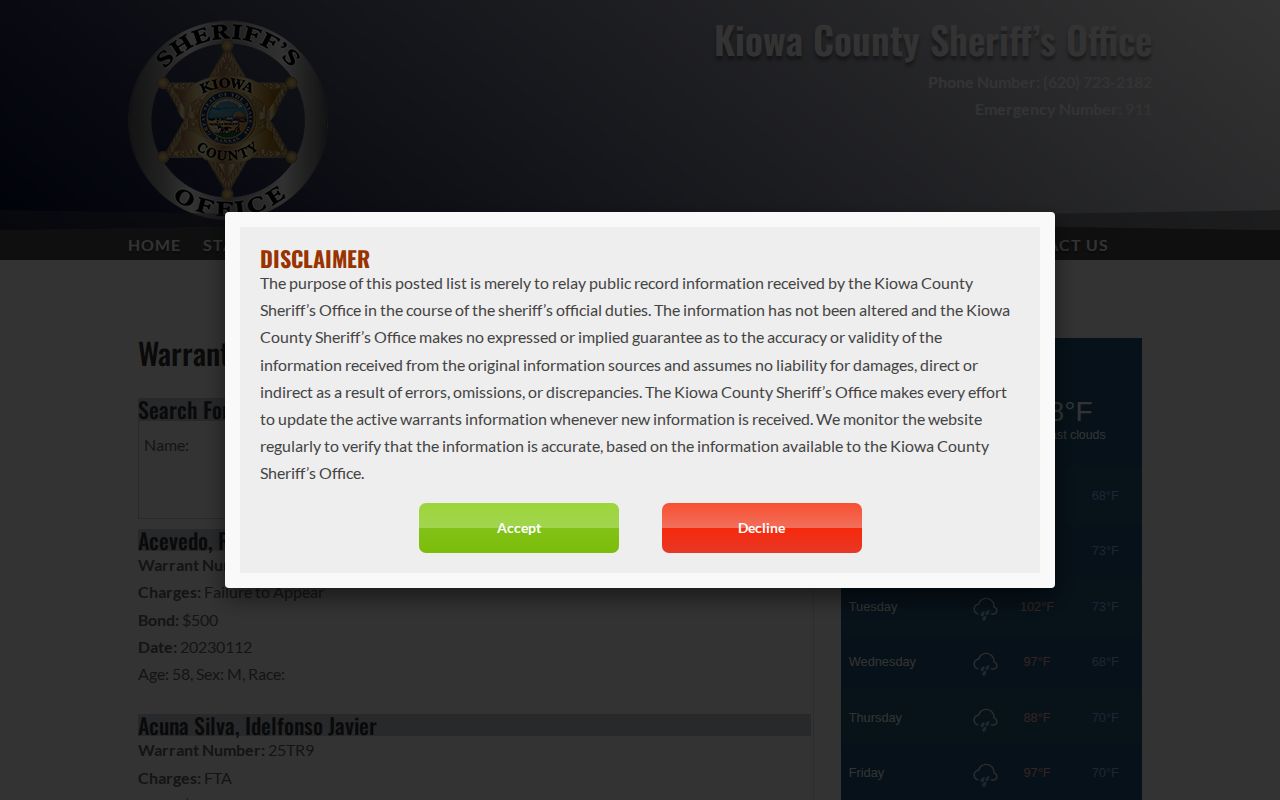
A captured image of the interface goes stale fast. It cannot reflect later additions, service, recalls, or corrections, so the live page is the only dependable option.
Note: A blank search result does not rule out a warrant, since spelling, jurisdiction, processing, and timing can all hide a match.
How to Check a Kiowa County Warrant
No standalone warrant page exists for Kiowa County here, and that is by design. This page carries the full check. The smart approach moves in stages. You start with an online lead, then confirm it through official channels, and only then turn to lawful resolution. Skipping a step invites trouble, so take them in order.
- Search the sheriff portal. Use the name field and record the warrant number and date shown for the possible match.
- Confirm with an official. Contact the Kiowa County Sheriff’s Office or the court connected to the case. Ask whether the warrant remains active and what identifier confirms identity.
- Check the court record. The Kansas Courts public portal can connect a name or case number to hearings and later case events when public access is available.
- Resolve it through lawful channels. A person who believes a warrant concerns them should contact a lawyer or the court and arrange the next step. Do not rely on advice about avoiding service.
Online court records have real limits. What you can see depends on the case type, any legal restrictions, and whether that court ever joined the statewide system. Some files simply never make it online. A courthouse terminal or a request to the clerk may reach a public record the internet will not show. One exception: sealed and expunged matters stay closed to everyone but the parties involved.
Warrant Types and Court Context
Every entry in the portal carries a charge/reason field. Read it, but don't lean on it too hard. Warrants don't all start the same way, and a short label can hide more than it reveals. For the true legal character of any warrant, the document itself and the court file behind it are the only trustworthy sources.
| Type | General context | Best confirmation |
|---|---|---|
| Arrest warrant | A judge authorizes an arrest in connection with an alleged offense after the required legal showing. | Sheriff and issuing court |
| Bench warrant | A court issues a command tied to a court obligation, such as an appearance or compliance issue. | Court clerk and case docket |
| Other recorded reason | The portal may use case-specific language that should be read exactly as displayed. | Warrant number and issuing court record |
Two terms in the portal cause regular confusion. "Bond" is a condition the court sets, often with money attached, tied to a person's release. A figure shown online may be outdated or incomplete, so only the court handling the case or the jail can tell you what actually applies today. "Disposition" refers to how the case ends later, whether by dismissal, acquittal, plea, or sentence. The warrant portal won't give you that. Case outcomes live in the court file, not in a warrant listing.
Safety Information and Sheriff Contact
Never confront, follow, restrain, or try to detain anyone because of a Kiowa County warrant result. That job belongs to law enforcement. If danger is immediate, call 911 right away. For anything less urgent, use the sheriff contact listed below. No anonymity promise or reward program appears anywhere official, so count on neither.
Kiowa County Sheriff’s Office200 E Wisconsin Ave
Greensburg, KS 67054
Non-emergency: 620-723-2182
Jail: 620-723-4155
The official sheriff contact page lists administrative staff hours as Monday through Friday, 8 a.m. to 4 p.m., closed on weekends and holidays. The county directory shows wider business hours overall, so a quick call ahead of any visit makes sense.
A screenshot of the sheriff's official contact route appears below. It comes in handy when the warrant portal can't confirm identity or status on its own.
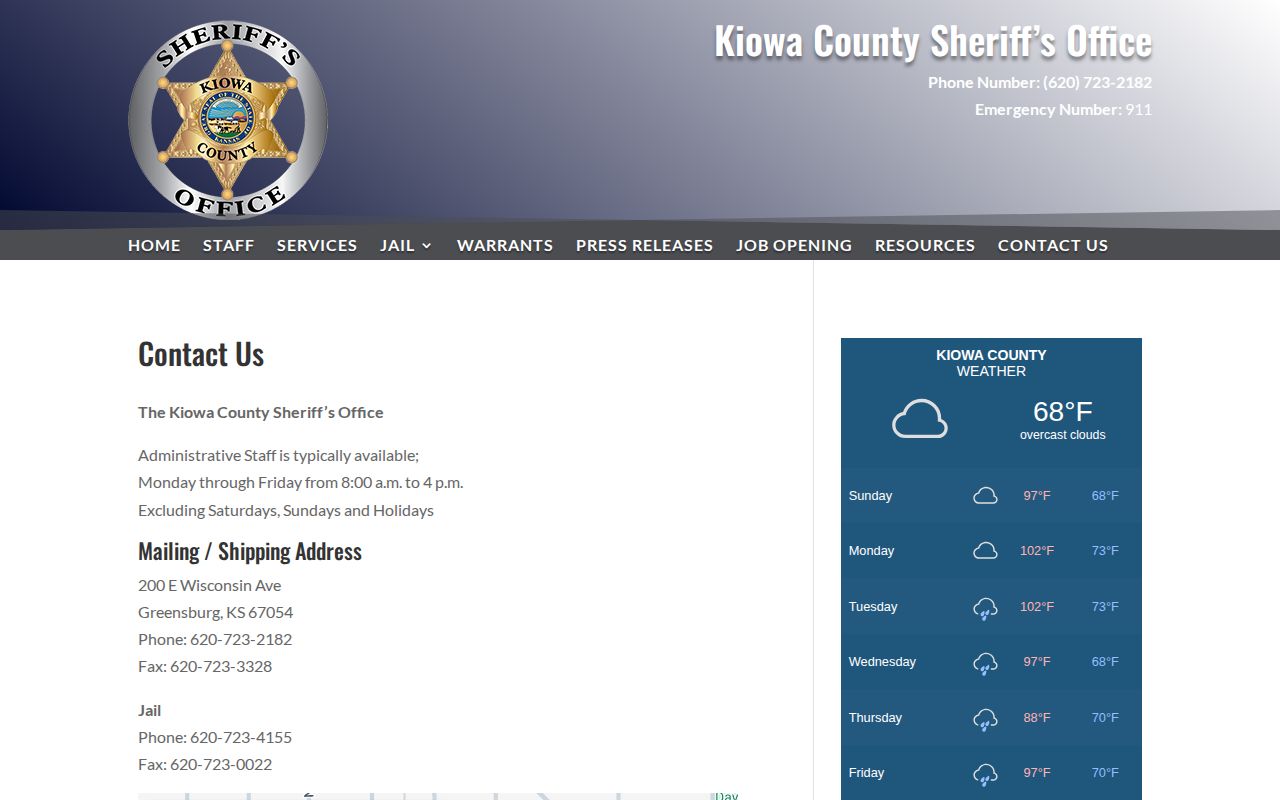
Skip the unofficial reposts floating around online. When you need to know whether a warrant entry is current, the sheriff's office itself is the source to ask.
Kiowa County Alerts Are Not Warrant Lists
Kiowa County's sheriff has no mobile app. The real digital options are few. They include the sheriff website and Facebook feed, Nixle alerts, press releases, and Kansas VINE. None of these is a systematic feed of warrants and photos.
The sheriff feed mixes content. Local posts sit beside statewide notices and reshares. Before tying any post to Kiowa County, check which jurisdiction it came from. Nixle sends community alerts, not warrant status. Kansas VINE tracks custody changes in participating county jails, but it leaves out KDOC prisoners, juveniles, and federal detainees.
Press releases describe major incidents. The official release archive posts them only as events occur. That episodic record can't replace the name-searchable warrant database. The same goes for the jail roster. A person's absence from it settles nothing about whether a warrant exists.
Confirming a Kiowa County Warrant Record
Use two sources together when confirming a Kiowa County warrant. The sheriff portal shows the active record. The statewide court docket adds the case number, parties, attorneys, judge, and hearings. Online access depends on court rules and on when a court joined the Kansas eCourt system. If a document is missing online, try a courthouse public terminal or a focused request to the clerk.
Call before visiting. Kiowa County District Court keeps weekday hours from 8 a.m. to 5 p.m. A quick call saves a trip. Give the clerk the person's name, warrant number, and any case number. Ask which court issued the warrant and whether the docket shows a recall or later action. Clerks explain record access. Legal advice belongs to an attorney.
Spotted an error on the sheriff's site? Contact KCSO with the exact portal URL, the warrant number, the displayed name, and the official document backing your correction. A written public-record request works too when a record exists but is not online. Under the Kansas Open Records Act, a custodian must act by the end of the third business day, though full production may take longer. KCSO's public-information form can go to 200 E Wisconsin Avenue in Greensburg or by email as the form directs. Keep the request narrow: name, warrant number, approximate date. Kansas law does not force an agency to create new answers to open-ended questions.
A warrant from another county or court stays that jurisdiction's business, even if the person lives nearby. Confirm the issuing jurisdiction first. This matters most near county lines or when a statewide post gets reshared. The source named on the warrant controls where confirmation begins.
Note: Sealed and expunged matters are not public, so an absent court result can reflect lawful access limits rather than a search failure.
From Warrant Allegation to Disposition
A warrant record is one step in a legal process. Charges can change. Cases end in dismissal or acquittal. Track the case through the issuing court, and rely on the final disposition rather than a search result to understand what happened.
Kiowa County sits in Kansas's 16th Judicial District. The district court is at 211 E Florida Avenue in Greensburg, phone 620-723-3317. The statewide portal shows public case details, but the clerk and the courthouse terminal still matter when documents are missing online.
Check the warrant number and court status before drawing conclusions. Similar names, stale data, or a recalled warrant can all point the wrong way without those checks.